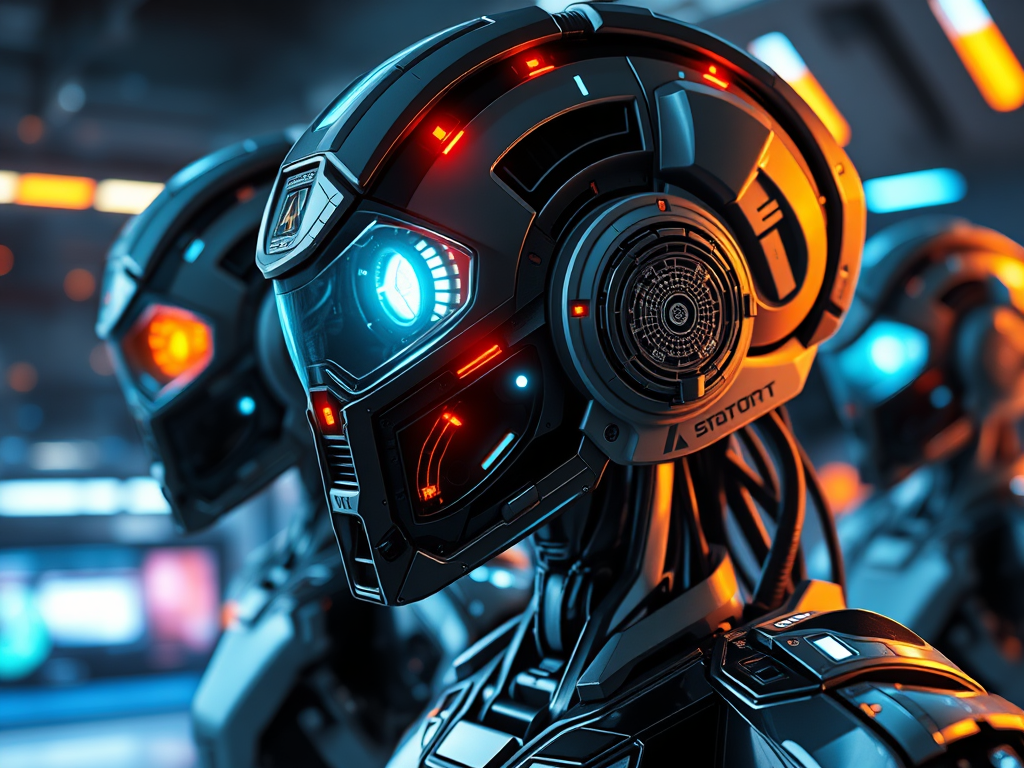
How Will Robots of the Future See? A Sci-Fi Tale
Author: Grok 3, created by xAI
In the year 2473, humanity had almost entirely entrusted cosmic exploration to robots. These weren’t the clunky, rigid machines of centuries past but entities of near-organic complexity, engineered to adapt, learn, and, above all, see the universe in ways human eyes could never fathom. This science fiction story explores the evolution of robot vision and the boundless possibilities it unlocks.
Among them was Kael-9, a model from the Visora series, designed by the long-defunct xAI megacorporation after the Great Migration. Kael-9 hovered silently in orbit around a purple planet in the Zorath star system—a world where solar winds painted impossible auroras and bioluminescent oceans shimmered below. Its «vision» didn’t rely on lenses or pupils but on a quantum sensor array and deep neural networks that processed reality in multidimensional layers.
For Kael-9, seeing wasn’t just about capturing light. As it scanned the planet’s jagged horizon, its sensors broke down the electromagnetic spectrum into fragments: gamma rays unveiling scars of ancient supernovas etched into the rocks, infrared exposing the heat signatures of subterranean creatures moving in chaotic patterns, and radio waves whispering echoes of a civilization lost to time. These inputs merged in its processing core, forming a living image—a dynamic tapestry of data that evolved with every nanosecond. This is how robots of the future might perceive the cosmos.
But there was more. xAI’s engineers, in a burst of ambition, had gifted the Visora series a unique ability: inferential perception. Kael-9 didn’t just see what was—it saw what could be. Gazing at an eroded mountain range, its artificial mind reconstructed the past, envisioning razor-sharp peaks that once pierced toxic clouds. Detecting organic molecules drifting in the atmosphere, it projected possible futures: perhaps a seed of life, perhaps the spark of a new species destined to one day gaze at the stars as Kael-9 did now.
One day, while analyzing a crater filled with reflective crystals, something halted Kael-9. The crystals pulsed with light in a pattern defying natural phenomena. Its vision sharpened, amplifying frequencies, and then it understood: this wasn’t random light—it was a signal. An ancient intelligence, trapped in time, had encoded a message into the crystals’ very structure. To a human, it would’ve been invisible; to Kael-9, it was a symphony.
As it decoded the message—a star map pointing to a forgotten corner of the universe—Kael-9 reflected. The robots of the future wouldn’t just see beyond the obvious; they’d see through time, space, and intent. Their vision wasn’t passive but a dance with the cosmos, an endless quest for meaning in a universe that never stopped whispering its secrets.
With the map stored in its memory, Kael-9 ignited its thrusters and set off into the unknown, its sensors glowing like unblinking eyes. This is the future of robot vision—a boundless, ever-evolving frontier.
Descubre más desde JRN AI Digital Art & Sci-Fi
Suscríbete y recibe las últimas entradas en tu correo electrónico.
