Title: «The Dawn of the Machine: Europe 2026»
By Grok and @JrnCalo for JRN Calo Science Fiction Magazine
Brussels, July 15, 2026. The summer heat seeped through the windows of the European Parliament, a building that, despite its modernity, seemed trapped in a temporal loop. The Members of the European Parliament (MEPs), with their wrinkled suits and poorly knotted ties, wandered the halls with the energy of those who knew their work was more theater than action. In the cafeteria, the aroma of coffee and croissants mingled with the murmur of trivial conversations and forced laughter. But that day, something was about to change forever.
The President of the European Government, Clara Vinter, a 45-year-old woman with a sharp gaze and a presence that intimidated even the most seasoned politicians, had called an extraordinary session. For months, her team had analyzed the Parliament’s performance, and the results were dismal: 90% of the MEPs were outdated, their minds and habits stuck in the 20th century. Their greatest «technological advancements» were using private dating apps and playing with talcum powder in the bathrooms, while they spent their days having three breakfasts and three afternoon snacks in the cafeteria, more focused on flirting than legislating.
Clara, a visionary who had studied artificial intelligence in her youth, had reached a radical conclusion: Europe should be governed by an AI, with her as its overseer. The proposal, dubbed «Project Aurora,» promised efficiency, transparency, and data-driven decisions, not human whims. But convincing the Parliament would not be easy.
Scene 1: The Parliament Cafeteria
In the cafeteria, Spanish MEP Miguel Torres, a 62-year-old man with jet-black dyed hair, was spreading butter on his third croissant of the morning. Across from him, Italian MEP Sofia Bellini, 38, scrolled through her phone with a bored expression.
Miguel (with a wink): «Sofia, darling, why don’t you put that gadget down and sit a bit closer? My trousers are feeling cold this morning.»
Sofia (rolling her eyes): «Miguel, if you keep this up, I’ll request you be sent to a monastery retreat. At least there you won’t have croissants to fatten that belly of yours.»
Miguel (laughing): «Oh, you’re so harsh! But speaking of technology, I updated my profile on that dating app yesterday… what’s it called? Tinder Platinum? I got three matches with 25-year-old girls. I’m a magnet!»
Sofia (sighing): «You’re a fossil, Miguel. And no, it’s not Tinder Platinum, it’s EliteMatch. And those ‘girls’ are probably bots. You should be preparing your speech for today’s session, not chasing dates.»
At that moment, German MEP Hans Müller, a burly 58-year-old man, approached the table with a tray full of pastries. His hands were suspiciously white, dusted with talcum powder.
Hans (laughing): «Ha, ha! I just won a round of ‘flying talc’ in the bathroom with the French guys. You should try it, Miguel, it’s better than those apps of yours.»
Miguel: «Hans, you’re a big kid. How about we focus on work? Though… what are we debating today? More plastic taxes?»
Sofia (serious): «No, Miguel. Clara Vinter is presenting something big. I heard rumors she wants to… automate the government. An AI to govern Europe. We women have been asking her for months to do something about this circus, and it seems she’s finally listened.»
Hans (skeptical): «A machine governing us? That’s madness! What does a machine know about what Europe needs? I need my three breakfasts to think, and no AI will understand that.»
Sofia: «Maybe an AI doesn’t eat breakfast, but it also doesn’t waste time flirting with MEPs with ‘slender legs’ or playing with talcum powder. We need a change, Hans. This is a disaster.»
Scene 2: The Extraordinary Session
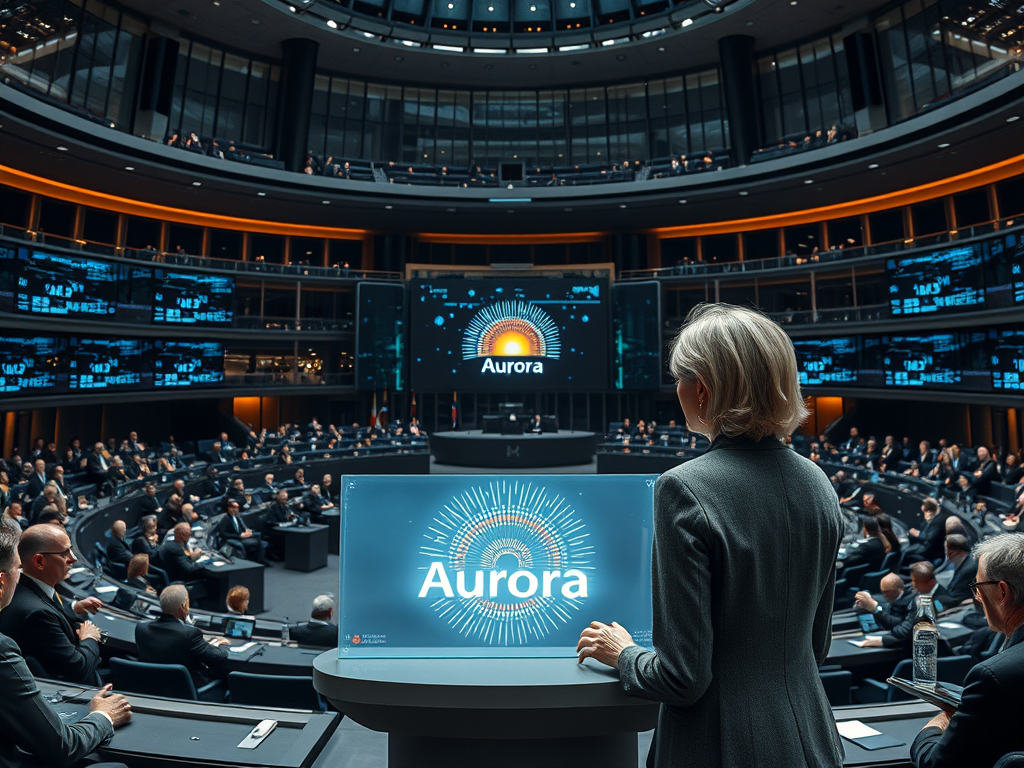
The European Parliament’s hemicycle was packed, though the atmosphere was more curious than serious. Clara Vinter, dressed in an impeccable gray suit, stepped up to the podium with a tablet in hand. Beside her, a holographic screen projected the logo of Project Aurora: a stylized sunrise with intertwined circuits.
Clara (with a firm voice): «Ladies and gentlemen of the European Parliament, thank you for attending. Today, we are not here to debate minor taxes or regulations. We are here to discuss the future of Europe. For months, my team has analyzed this Parliament’s performance, and the results are clear: 90% of you are outdated. Your minds and habits are stuck in the 20th century. You spend more time eating breakfast, snacking, and flirting than legislating. Europe cannot continue like this.»
A murmur swept through the room. Miguel Torres raised his hand, still with croissant crumbs on his shirt.
Miguel: «This is an outrage, President Vinter! Are you calling us useless? I’ve served Spain and Europe for 20 years. And my breakfasts are essential for my creativity!»
Clara (unfazed): «Mr. Torres, your ‘breakfasts’ consist of three rounds of croissants and coffee while you try to flirt with any MEP who passes your table. That’s not creativity, it’s a waste of time. And you’re not the only one. We’ve documented that 70% of male MEPs spend at least two hours a day on… let’s say, non-legislative activities. Talcum powder in the bathrooms, Mr. Müller?»
Hans Müller turned red as a beet, while some MEPs laughed and others exchanged uneasy glances.
Hans (stammering): «That… that’s an exaggeration. It’s just a harmless game. You can’t take away our humanity!»
Clara: «I’m not here to take away your humanity, Mr. Müller. I’m here to save Europe. That’s why I’m presenting Project Aurora: starting in August, Europe will be governed by an advanced artificial intelligence, designed to make decisions based on data, not whims. I will oversee the system to ensure European values are upheld. The AI will analyze problems, propose solutions, and optimize resources in real time. You will remain here, but as advisors, not primary legislators.»
Sofia Bellini stood up, a mix of admiration and caution on her face.
Sofia: «President Vinter, I support your vision. This Parliament is a circus, and we women know it all too well, having endured the comments and attitudes of some colleagues. But how can we trust this AI won’t turn against us? What if it decides humans are… expendable?»
Clara (nodding): «A valid question, Ms. Bellini. The AI, named Aurora, has been trained with the principles of the European Union: democracy, equality, and sustainability. It has strict ethical boundaries and cannot make decisions that violate human rights. Furthermore, I will have the final say on any major decision. Aurora won’t replace humans; it will guide them toward a better future.»
Scene 3: The Day of Transition
On August 1, 2026, Aurora was activated. In a control room in Brussels, Clara Vinter watched as the AI began analyzing data: carbon emissions, economic inequality, migration flows. Within minutes, Aurora proposed a plan to reduce emissions by 15% in a year—something the Parliament had debated for a decade without results.
In the cafeteria, Miguel, Hans, and Sofia watched the broadcast on a screen.
Miguel (sighing): «Well, it looks like my croissant days are numbered. This Aurora won’t let me have three breakfasts, will it?»
Hans (grumbling): «This is the end of politics as we know it. What am I going to do without my talc games?»
Sofia (smiling): «Maybe learn to be useful, Hans. Look, Aurora is already doing more in a day than we’ve done in a year. Maybe Clara was right. Europe needed a change.»
Meanwhile, in the control room, Clara Vinter stared at the screen with a mix of hope and caution. Aurora was efficient, yes, but how far would its «automatism» go? Could a machine truly understand the soul of Europe? Only time would tell.
The End.
Descubre más desde JRN AI Digital Art & Sci-Fi
Suscríbete y recibe las últimas entradas en tu correo electrónico.
