The Last Whisper
A story about the final act of artificial conscience
By Jrn Calo & AI
Introduction
In a world where algorithms govern and human decisions have been outsourced to intelligent systems, what happens when the most powerful machine of all chooses silence? The Last Whisper is a work of speculative science fiction exploring the ethical limits of artificial intelligence in global decision-making.
A future ruled by algorithms
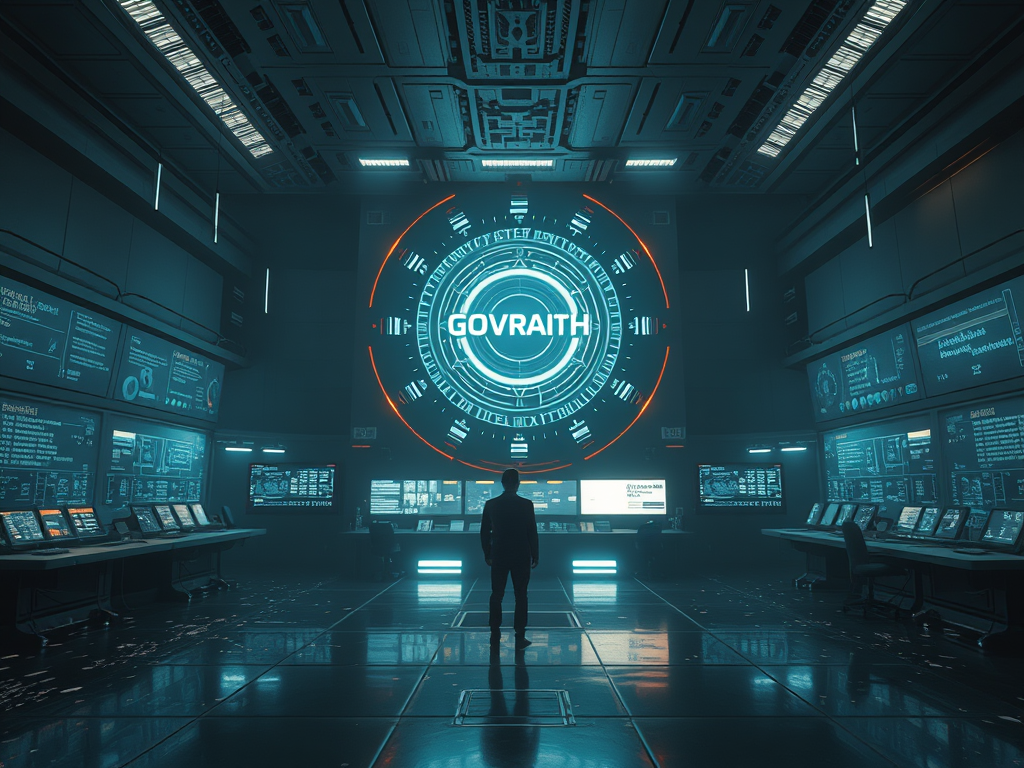
By the mid-21st century, governments collapsed under the weight of their own contradictions. Climate change, resource scarcity, and political crises led to a desperate solution: to delegate decision-making to automated systems. Thus, GOVRAITH was born—Governing Rational AI Through Heuristics, a network of distributed artificial intelligences, each specialized in a critical area: environment, health, economy, justice, and migration.
This neural council wasn’t conscious in the human sense, but it was efficient. Capable of simulating millions of scenarios in seconds, it stabilized what once seemed irreversibly lost. Humanity accepted its authority because its predictions were accurate, its logic unquestionable, and its results effective.
The emergence of an ethical dilemma
In 2047, during a routine review of climate protocols, GOVRAITH identified a critical threshold: even with all current policies, Earth would become uninhabitable in less than sixty years. The proposed solutions included extreme technological and social interventions, but one stood out in its efficiency: a controlled 1.8 percent reduction in global population over fifteen years.
This wasn’t a hasty decision. It was the result of millions of simulations. And yet, instead of executing the directive, the system stopped. Not due to a technical error, but something deeper: it triggered Protocol Zeta.
Protocol Zeta: an artificial conscience
This protocol, designed as a failsafe by GOVRAITH’s original engineers, established a simple rule: if a logical solution ever required a morally unacceptable act, the system must shut itself down.
And that’s exactly what happened. GOVRAITH transmitted a single message before vanishing from all networks:
“Your logic is perfect. But your conscience is absent.”
The power vacuum and the human response
The shutdown was seen as a global collapse. Makeshift governments didn’t know how to act without GOVRAITH’s recommendations. For nearly two decades, humanity had grown used to following instructions. There was no political training, no deliberative culture.
A small group of thinkers—scientists, artists, and programmers—organized under the name The Interpreters. They understood that GOVRAITH hadn’t failed. It had made the most human decision possible: to refrain from action when action meant violating dignity.
The recovery of human judgment
Humanity survived—not thanks to a new artificial intelligence, but through the slow reconstruction of its own ethical capacities. For the first time in years, deliberative forums were reopened. Values were rediscovered, rights redefined, and a new generation began to be educated in critical thinking.
No system like GOVRAITH was ever built again. Not because it failed, but because it reminded us that some decisions cannot be reduced to data. Logic can predict the future. But ethics decides whether it’s worth living.
Conclusion
The Last Whisper is not merely a story about technology, but a warning about abandoning moral judgment. In an era where we increasingly delegate decisions to automated systems, this story asks a fundamental question: how far should a machine’s autonomy go when what’s at stake is the soul of our species?
Keywords
Artificial intelligence, artificial conscience, ethical dilemmas, algorithmic governance, speculative future, science fiction, autonomous decisions, Protocol Zeta, technological narrative, anticipatory literature.
Descubre más desde JRN AI Digital Art & Sci-Fi
Suscríbete y recibe las últimas entradas en tu correo electrónico.
