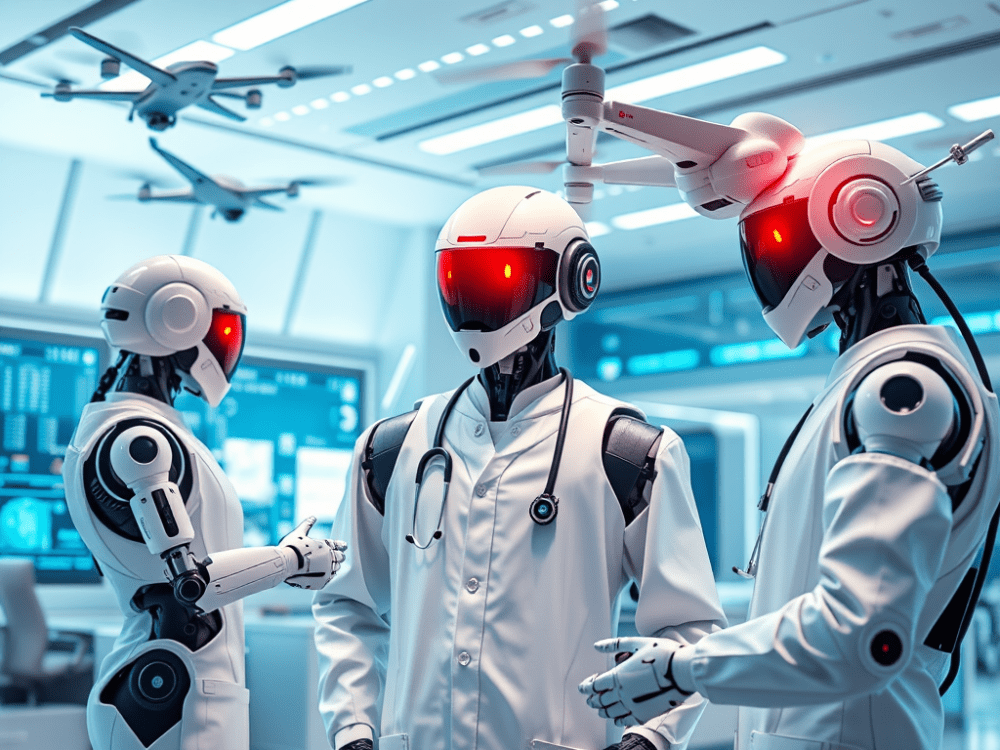
The Day the Algorithms Shut Down: An Apocalyptic Science Fiction Story
Meta Description (SEO): A dystopian science fiction story set in 2025, when artificial intelligence and algorithms suddenly shut down. Explore the chaos of a global digital blackout and the unexpected rediscovery of humanity.
Have You Ever Imagined a World Without Algorithms?
In this dystopian science fiction story, we explore a near future where artificial intelligence and algorithms suddenly shut down, leaving humanity at the mercy of its own ingenuity.
Set on August 27, 2025, this apocalyptic tale reflects on our dependence on future technology, social networks without filters, and the chaos of a global digital blackout. If you are looking for speculative fiction about the end of the digital age, keep reading.
Introduction: The Digital Silence That Changed Everything
Imagine a world where, overnight, everything stops. No explosions, no nuclear catastrophes, no alien invasions. Just digital silence. It was August 27, 2025, an ordinary Wednesday, when the algorithms shut down.
No one knows why. Some blamed a solar electromagnetic pulse, others a massive hack orchestrated by a modern-day Luddite collective. But the result was the same: the invisible brain that governed our lives simply flickered and went out.
In this science fiction story, we explore the consequences of an AI blackout in cities like New York, Beijing, and Silicon Valley. From chaos in the streets to the unexpected liberation of humanity, this tale highlights themes such as technological dependence, failed algorithmic trading, and the rediscovery of the analog world. Perfect for fans of technological dystopias like Black Mirror or 1984.
The Dawn of Chaos: When Algorithms Fail
It was a gray Wednesday in 2025, in a megacity where the sky was perpetually covered by a veil of floating data. I, a forgotten software engineer buried in a giant corporation, awoke to a deafening silence.
My neural implant, which usually flooded me with personalized updates—news, reminders, breakfast suggestions based on my biorhythm—was mute. I tried to activate it with a mental gesture, but nothing. Only a digital void.
I stepped onto the balcony, and the chaos hit me like a wave. Streets, normally orchestrated by traffic algorithms, were a labyrinth of stalled autonomous vehicles. Electric cars stopped in the middle of intersections, with confused passengers stepping out, staring at their inert devices. Delivery drones fell from the sky like dead leaves, their AI-optimized routes gone. A nearby traffic light blinked randomly, no longer following the predictive pattern that prevented accidents.
In New York, Sarah woke up to her smartphone turned into a useless brick. No Netflix recommendations, no Google Maps routes, no endless feeds on X or Instagram. She tried to order an Uber, but the app wouldn’t respond. “Connection error,” it said, but it wasn’t just that. Servers, dependent on optimization algorithms and machine learning, collapsed in a chain reaction. Traditional taxis returned to the streets, with human drivers shouting out fares like in the old days.
Impact on Social Networks and Communication
On social networks, the chaos was worse. Or rather, there were no networks. Servers, reliant on recommendation and moderation algorithms, collapsed under the weight of raw, unfiltered human interaction.
People shouted in the streets, organizing improvised gatherings. “What happened to the feed?” a young man asked a group of strangers. “I don’t know what to watch, what to buy, what to think!”
In Beijing, Li Wei, an AI engineer, stared at a blank screen. The facial recognition surveillance systems that maintained social order had gone blind. Cameras still recorded, but without algorithms to analyze patterns, they were just inert eyes. The city, usually so controlled, filled with organic buzz: people chatting in the streets, unafraid of being scored by an invisible social rating system.
The Unexpected Liberation: Rediscovering Humanity
Not everything was chaos. In Silicon Valley, big tech employees stepped out of their glass offices, confused but curious.
Without algorithms recommending content, people rediscovered physical books, face-to-face conversations, and impulsive decisions. Do you remember when you chose a movie based on a gut feeling, not on a 98% match? That came back.
Social networks, now silent, forced people to truly reconnect: phone calls, handwritten letters, surprise visits.
In parks, people sat to talk without distractions. Dusty books reemerged from shelves, and children played without screens dictating their movements. Artists painted without worrying about likes, and musicians played for real audiences, not virtual ones.
Economic and Medical Consequences
The financial markets collapsed within hours. Without high-frequency trading algorithms, human investors reverted to primal instincts: buy in panic, sell in fear.
Stock exchanges closed indefinitely, and the value of digital money—existing only on blockchains maintained by AI—evaporated like smoke. Wall Street became a marketplace of shouting and hand signals, like in the 1980s movies. Prices fluctuated based on human intuition, not millisecond-to-millisecond predictions.
In hospitals, doctors rediscovered the lost art of diagnosing without assistance. Life support machines ran in manual mode, but epidemic prediction systems were mute. A common flu turned into a threat because no one had forecasted its spread without predictive models.
In vertical urban farms, automated irrigation systems failed, threatening entire crops. Food, once managed by supply chain algorithms, began to run scarce within hours.
Conclusion: A Reset for Humanity
I, a programmer who had dedicated his life to perfecting those very algorithms, found myself wandering aimlessly.
For the first time in decades, I made decisions based on intuition: I entered an old café, ordered a black coffee without personalized recommendations, and chatted with the barista about the real weather, not the forecasted one.
At sunset, rumors spread: a global cyberattack, an error in the quantum network, or perhaps a rebellion of the machines that decided to shut themselves off. Nobody knew for sure.
But in that void, something forgotten emerged: humanity without intermediaries.
Was it the end? No. It was a reset. The next day, engineers began to rebuild, but with a lesson engraved: algorithms served us, but we were the ones who had to control the switch.
This apocalyptic fiction invites us to reflect on our present world, where AI and algorithms dominate everything. Are we ready for a day without algorithms?
Descubre más desde JRN AI Digital Art & Sci-Fi
Suscríbete y recibe las últimas entradas en tu correo electrónico.
