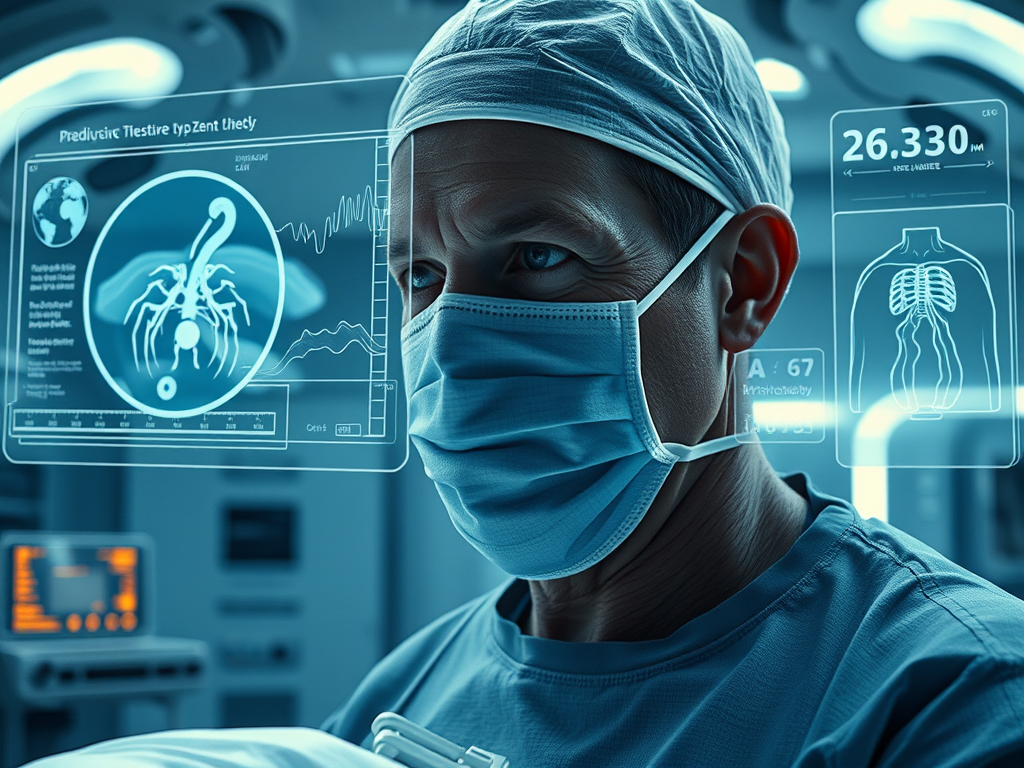
By 2036, artificial intelligence will not replace physicians. It will restructure hospital authority, redefine clinical prestige, and transform how surgeons interact with predictive systems in New York and London.
2036: The Surgeon Competing Against His Own Predictive Model
Manhattan, 2036.
The operating room is silent except for the hum of computational processing.
Above the surgical field, a transparent interface projects probabilities in real time.
4.2 million simulated surgical trajectories.
Complication likelihood reduced by 3.8% with an alternative approach.
The model was trained on the surgeon’s own historical cases.
He is not being replaced.
He is being statistically benchmarked against himself.
The Misframed Debate
Public discourse continues to ask the wrong question:
Will AI replace doctors?
It will not.
The transformation underway is structural, not occupational.
Artificial intelligence is shifting the center of clinical authority.
From Assistant to Structural Baseline
In leading institutions such as:
- NYU Langone Health
- Mount Sinai Health System
- UCLH NHS Foundation Trust
AI systems already contribute to:
• Real-time surgical risk modeling
• Radiology image interpretation
• Early sepsis detection
• Predictive ICU deterioration alerts
Multiple peer-reviewed studies in Nature Medicine and The Lancet Digital Health show that hybrid human-AI models outperform either alone in defined clinical domains.
The clinical baseline is becoming algorithmic.
The physician remains central — but no longer solitary.
2036: The Redistribution of Authority
If predictive systems consistently outperform individual intuition in defined scenarios, three structural shifts follow:
- Clinical authority becomes shared between human reasoning and algorithmic validation.
- Medical education incorporates model governance and uncertainty interpretation.
- Professional prestige redefines itself around system oversight, not isolated brilliance.
The most respected surgeon in 2036 will not be the fastest hands.
It will be the clinician who understands when to override a model — and when not to.
The Emerging Cognitive Risk
The danger is not automation.
It is predictive dependency.
When every critical decision routes through an interface:
• Average safety increases.
• Cognitive load decreases.
• Autonomous reasoning may gradually erode.
The challenge for New York and London medical schools is epistemological.
How do you train physicians who supervise systems rather than defer to them?
Cultural Anticipation
Long before clinical AI matured, culture anticipated this structural shift:
- Blade Runner explored identity under artificial systems.
- Ex Machina questioned control and agency.
- Westworld examined power redistribution when systems learn faster than their creators.
These were not stories about replacement.
They were stories about hierarchy.
The Structural Question
By 2036, the central tension in medicine will not be human versus machine.
It will be:
Doctors competing against predictive systems
versus
Doctors trained to govern them.
Final Question
Do we want physicians trying to outperform algorithmic prediction,
or physicians capable of directing it?
Descubre más desde JRN AI Digital Art & Sci-Fi
Suscríbete y recibe las últimas entradas en tu correo electrónico.
