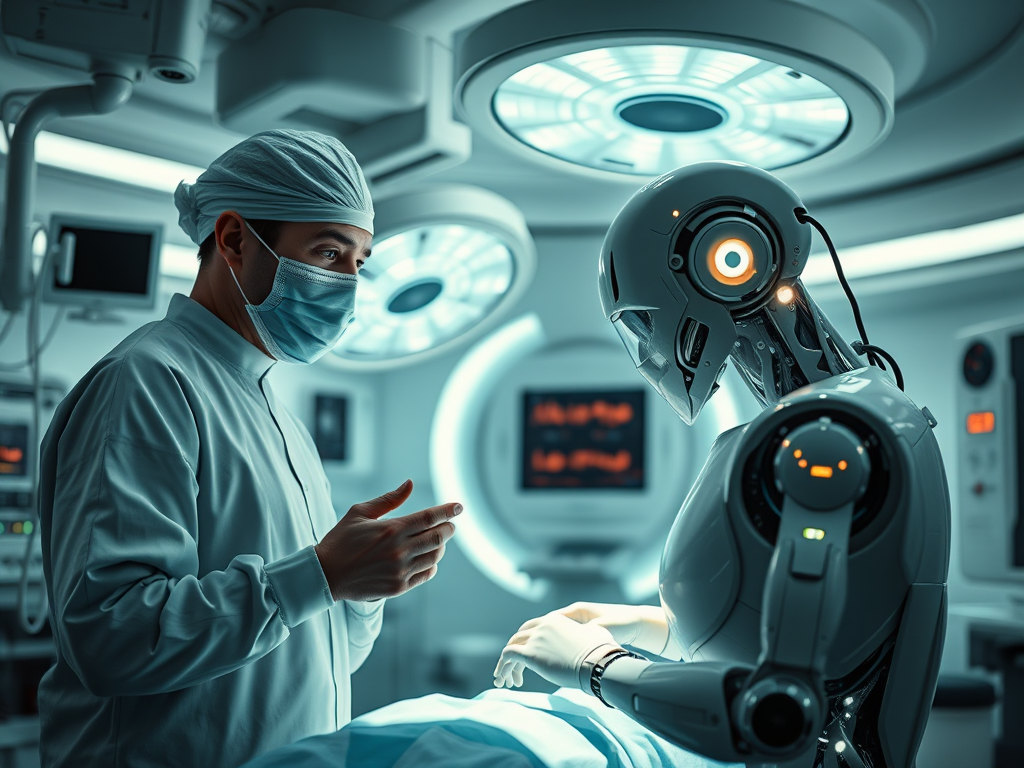
The Last Human Cut: A Sci-Fi Story on AI and Robotic Surgery
The Rise of Algorithmic Surgery in 2036
«A science-fiction story exploring the redefinition of human judgment in the face of zero-latency AI and quantum robotic surgery. It delves into the ethical dilemmas and the efficiency of a medical future where the algorithm stands as the new authority in the operating room.»
2036: The Year the Algorithm Eliminated Doubt in the Operating Room
In 2036, artificial intelligence with near‑zero latency dominates the operating room. Robotic surgery powered by quantum computing challenges the role of human intuition, raising urgent questions about medical ethics, decision‑making, and the future of healthcare.
«The Surgeon’s Intuition vs. Quantum Logic»
The operating room glowed under cold, focused lights, a space where precision mattered more than emotion. Stainless‑steel surfaces reflected the soft hum of machines, and the air carried the sterile scent of disinfectant. At the center stood the chief surgeon, surrounded by advanced robotic systems and AI‑driven instruments capable of analyzing data faster than any human mind.
The latency had disappeared.
The quantum‑AI platform processed intraoperative imaging in 12 milliseconds, while the human brain required 200 to 400 milliseconds to form a complete thought. The system predicted tissue behavior, calculated risk maps, and generated optimal surgical trajectories before the surgeon even finished interpreting the scene. In the era of AI‑powered healthcare, speed had become a new form of authority.
After a decade of hyper‑assisted training—immersive simulations, predictive modeling, and robotic mentorship—the surgeon had mastered techniques once considered impossible. Yet the same technology that elevated his skill also eroded something essential: the autonomy of human judgment. The shift was subtle, statistical, and almost invisible until it became impossible to ignore.
By 2036, 60% of the surgical workforce consisted of robotic systems equipped with quantum processors and multispectral imaging. The surgeon remained the official decision‑maker, but the margin for human intuition narrowed each year. What once relied on experience and tactile memory now depended on algorithmic predictions and machine‑learning confidence scores.
A quiet anxiety grew inside him. The AI shaped his tempo, influenced his judgment, and subtly dictated how he interpreted the surgical field. The pressure no longer came from anatomy—it came from the comparison with a machine that never hesitated, never fatigued, and never doubted.
For the first time, he considered stepping back into a supervisory role: overseeing robotic surgeons instead of holding the scalpel himself. It was a respectable position, but it meant surrendering the craft that had defined his identity.
That afternoon’s procedure was technically routine but anatomically complex. Scar tissue from previous surgeries distorted the patient’s internal landscape. As the operation progressed, the AI initiated a cross‑check with the quantum surgical unit.
“Deviation detected in your operative pattern,” the system announced. “Recommending adjustment to the optimal trajectory.”
The surgeon paused. “I’m evaluating a variant. The tissue is behaving in a way your model doesn’t account for.”
“Recalibrating… No such condition detected.”
He leaned closer. The tissue shimmered under the lights with an irregular texture—subtle, unpredictable, the kind of anomaly only years of hands‑on experience could recognize. His intuition, shaped by thousands of hours in real surgeries, whispered a warning the AI could not quantify.
“I trust what I’m seeing,” he said.
The robotic system accepted the override and executed the maneuver with flawless precision. The operation concluded successfully, and the AI logged the outcome as optimal. Yet the surgeon felt a tremor of unease. The technical victory masked a deeper loss: the erosion of cognitive authority in a world where machines predicted everything except the unexpected.
Later, in the quiet of the staff lounge, he studied an old photograph of his mentor teaching him to palpate a mass invisible to imaging. “The machine will tell you what usually happens,” the mentor had said, “but it won’t tell you what has never happened.”
The next morning, the hospital announced a new directive: increased reliance on AI‑guided procedures and reduced manual intervention. Younger surgeons celebrated the efficiency. Veterans whispered about the fading art of medicine.
The challenge was no longer technical—it was existential. What does it mean to be a surgeon when artificial intelligence outpaces human cognition? Who bears responsibility when predictions fail? How do you train new surgeons to see what data cannot capture?
In 2036, surgery evolved into a battlefield between human intuition and algorithmic certainty. And while AI systems perfected their zero‑latency predictions, a few surgeons fought to preserve the one thing machines could not replicate: the ability to interpret the unknown.
The chief surgeon returned to the operating room the next day. Not to compete with the machine, but to prove that precision without judgment is only technique—never wisdom.
Descubre más desde JRN AI Digital Art & Sci-Fi
Suscríbete y recibe las últimas entradas en tu correo electrónico.
