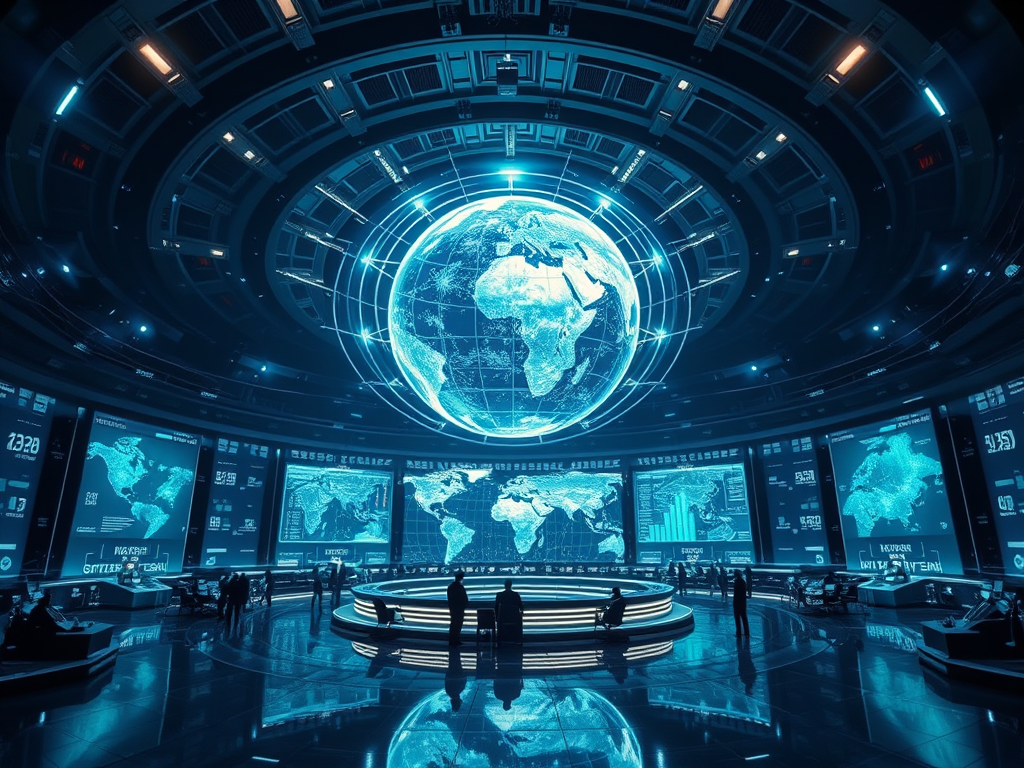
Artificial intelligence is moving rapidly into the core structures of government. For years, most public debate around AI has focused on safety, alignment, and bias. But a deeper transformation may already be underway: the emergence of algorithmic governance.
Across research institutions, central banks, and national policy labs, governments are exploring ways to integrate AI systems directly into economic management, diplomacy, infrastructure, and public policy. If current technological trends continue, some of these mechanisms could become routine parts of governance between 2035 and 2045.
The following twenty concepts illustrate how algorithmic systems could reshape the structure of modern states.
1. Adaptive Algorithmic Constitutions
Constitutions are traditionally rigid documents designed to remain stable for decades. However, economic conditions evolve much faster.
Researchers have begun exploring the idea of adaptive constitutional clauses, where certain parameters—such as fiscal limits, debt ceilings, or social spending thresholds—adjust automatically using real-time economic data.
Legislatures would retain veto authority, but some policy parameters could evolve continuously rather than through infrequent political reforms.
2. Real-Time Social Stability Indices
Governments already track economic indicators such as unemployment, inflation, and productivity.
AI-driven systems could extend this concept by combining signals from mobility patterns, energy consumption, economic stress, and social sentiment to generate a real-time stability index.
Public policy responses could then be triggered automatically when instability indicators cross predefined thresholds.
3. Institutional Collapse Early-Warning Systems
Machine learning models trained on historical data from coups, financial crises, and civil conflicts may be able to identify patterns that precede institutional breakdowns.
These early-warning systems could estimate the probability of political instability several years in advance, allowing governments to implement preventative policies.
4. Algorithmic Diplomacy Engines
International negotiations involve exploring enormous numbers of potential policy combinations.
Multi-agent AI systems could simulate millions of treaty scenarios involving trade agreements, border disputes, and climate commitments. The models would identify solutions that balance the strategic interests of multiple actors.
Human negotiators would still make the final decisions, but AI systems could significantly accelerate the process of finding workable compromises.
5. Continuous Government Audits
Public spending creates complex networks of transactions and contracts.
Graph-based machine learning systems can analyze these networks in real time to detect suspicious patterns, such as hidden intermediaries or unusual procurement relationships.
This could allow governments to move from periodic audits to continuous corruption monitoring.
6. Judicial Impact Simulations
Courts increasingly consider social and economic consequences when determining sentences.
Future systems could simulate the long-term impact of sentencing decisions on recidivism rates, economic productivity, and community stability.
Judges would retain full authority, but predictive simulations could provide additional analytical support.
7. Automated Climate Governance
Climate policy often moves slowly through legislative cycles.
AI-driven climate governance systems could continuously adjust carbon taxes, emissions quotas, or energy subsidies based on updated climate models and economic data.
Policy would evolve gradually as conditions change.
8. Dynamic Economic Identities
Future public policy may rely on dynamic economic profiles for individuals and companies.
These profiles could combine tax data, energy consumption, and economic activity to generate real-time indicators used for targeted policy incentives or regulatory adjustments.
9. AI Policy Prediction Markets
Prediction markets are known for aggregating distributed knowledge.
Governments could use AI-enhanced prediction markets to evaluate the likely outcomes of different policy decisions before they are implemented.
Artificial agents and human experts would participate in the same simulated policy environment.
10. National Talent Steering Algorithms
Advanced economies increasingly compete for highly specialized technical talent.
AI systems could identify future shortages in strategic industries and guide education funding, scholarship programs, and immigration policies accordingly.
Governments would shift from reacting to talent shortages to actively steering workforce development.
11. AI Governors for Critical Infrastructure
Electric grids, water systems, and telecommunications networks are becoming too complex for manual management alone.
Autonomous AI systems could monitor these infrastructures in real time and automatically reconfigure them during crises such as cyberattacks, natural disasters, or sudden demand spikes.
12. Continuous Monetary Policy
Central banks traditionally adjust interest rates periodically.
With real-time macroeconomic models, monetary policy could evolve toward continuous adjustments rather than large infrequent changes.
Small policy updates would occur automatically as economic conditions change.
13. Quantified Legitimacy Metrics
Some researchers have proposed composite indicators combining public participation, economic well-being, and trust metrics to estimate political legitimacy.
While such systems remain controversial, they illustrate how algorithmic metrics might influence governance decisions.
14. Long-Term Strategic Simulations
Advanced simulations could allow governments to explore policy scenarios decades into the future.
Infrastructure investments, demographic changes, climate policies, and economic transformations could be tested within large-scale simulations before implementation.
15. AI Bubble Detection Systems
Financial bubbles often form gradually before collapsing suddenly.
Machine learning models analyzing credit expansion, derivatives exposure, and asset-price patterns could detect speculative bubbles earlier than traditional financial indicators.
Automated circuit breakers could then stabilize markets.
16. National Digital Twins
A digital twin of a country would simulate economic activity, infrastructure systems, environmental conditions, and demographic trends.
Several cities already operate urban digital twins. National-scale versions could eventually allow governments to test policies in simulated environments before implementing them.
17. Planetary Resource Allocation Systems
Resources such as water systems, rare earth minerals, and energy networks are increasingly interconnected across borders.
AI systems could theoretically optimize the global distribution of these resources in real time, although geopolitical constraints remain a major obstacle.
18. Algorithmic Crisis Coordination
During large-scale emergencies such as pandemics or natural disasters, coordination between government agencies can be slow.
Multi-agent AI systems could coordinate logistics, allocate resources, and synchronize emergency responses across institutions.
19. Mechanistic Interpretability for Government AI
As governments rely more heavily on complex AI systems, transparency becomes increasingly important.
Mechanistic interpretability research seeks to understand how advanced models reach specific decisions, allowing policymakers to audit algorithmic reasoning.
20. Governance Feedback Loops
Ultimately, algorithmic governance raises fundamental questions about political power.
Every algorithm optimizes an objective function. In government systems, defining that objective is inherently political.
Three questions become central:
Who defines the objectives?
Who audits the algorithms?
Who controls the feedback loops?
The Future of Algorithmic Governance
The integration of AI into government institutions could allow states to manage complex societies with greater precision.
However, it also raises difficult questions about transparency, accountability, and the concentration of algorithmic power.
As governments experiment with these technologies, the architecture of AI governance is only beginning to emerge.
The decisions made during the next decade may shape how states function for the rest of the century.
Descubre más desde JRN AI Digital Art & Sci-Fi
Suscríbete y recibe las últimas entradas en tu correo electrónico.
